


8. Linden
The linden (American Tilia), commonly called American basswood, is a stately native shade tree suitable for cultivation in Zones 2 to 8.
This beloved species has been cultivated in North American gardens since 1752.
American basswood develops a pyramidal form with large, dark green leaves displaying silvery undersides. The leaves turn golden yellow in fall.
At maturity, expect heights of 50 to 80 feet with a 30- to 50-foot spread, adding 12 to 24 inches of growth per year.
Plant in moist, deep, well-drained soil in full sun. Linden tolerates a range of soil pH levels and is moderately salt tolerant.

You can find American linden available at Nature Hills Nursery.
The sweetly scented yellowish-white flowers open in early summer, attracting dozens of bees and other pollinators.
Beekeepers prize linden honey as some of the finest available and the wood from American basswood is traditionally used for beehive frames.
The tree also serves as a host plant for several moth and butterfly species.
Learn how to grow lindens here.
9. Paulownia
When I first moved to Philadelphia, I marveled at what I first thought were sweeps of wisteria in the trees growing along the highway.

A few weeks later I learned that these were the flowers of the paulownia or Royal Empress tree (Paulownia tomentosa).
Suitable for Zones 6 to 9, this is a beautiful specimen that offers a 30- to 40-foot height with a similar spread, adding 24 inches per year.
The leaves on young specimens are massive and in the fall the foliage drops without changing color.
Despite being beautiful, paulownia is also plagued by weak and brittle wood, roots that pop through the surface of the soil, and a weakness to cold snaps in the spring.
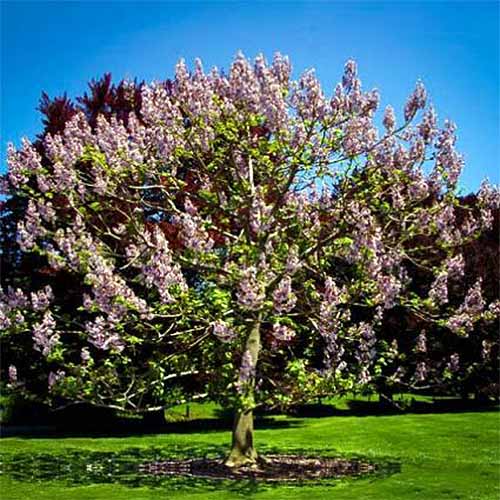
You can find paulownia available from Nature Hills Nursery.
They are also a very vigorous seeder; check locally to see if the paulownia is considered an invasive species in your area.
If paulownia has a more specific or pressing issue, it is that it is a voracious grower and will seed far and beyond your intended planting area.
10. Pecan
The pecan (Carya illinoinensis) is no stranger to Texas, where it is the state tree.
Offering delicious nuts and an incredible height and spread – 70 to 100 feet tall and 40 to 70 feet wide – few trees offer as many benefits as the pecan.

If you have room, plant three or four specimens to guarantee pollination and a crop of tasty pecans.
They tolerate a variety of soil types in Zones 6 to 9 and will add as much as 24 inches of height per year.
There are a handful of different varieties available, including Desirable, Elliot, Pawnee, Stuart, Sumner, and Hardy pecan.
The biggest downside to pecans is that they grow a large taproot, making it difficult to transplant except when they are very young and small.

You can find Elliot pecans available at Fast Growing Trees.
They can produce over 100 pounds of nuts a year.
Find pecan tree growing and care instructions here.
11. Quaking Aspen
Among the oldest and largest organisms on the planet, the quaking aspen (Tremulous people) is an excellent choice for a shade tree – if you have the room for it.

Hardy in Zones 1 to 7, it prefers moist soil, and shoots out suckers that will eventually grow into full-sized specimens.
This colony of trees can be a blessing if you have enough space, but can be problematic if planting in a more controlled area.
Quaking aspen earns its name from the unequivocally soothing sound of its leaves fluttering en masse in the slightest of breezes.
It grows to mature heights of between 30 and 50 feet with a spread of 20 to 30, adding two feet per year.
Remember that this tree grows in its own colony, and can form an effective, impenetrable shade screen when allowed to go wild.

This fast-grower is available from Fast Growing Trees.
With stunning yellow foliage in the fall, it requires a massive cleanup. Again, the quaking aspen is not a tree to grow in a controlled area.
When grown outside of its natural northern ranges, quaking aspen can be impacted by heat stresses and fungal problems.
This species is also a magnet for wildlife. Unfortunately, this wildlife can come in the form of pests such as aspen borers and tent caterpillars.
Borers can invite future fungal problems, and tent caterpillars cause branch die-off. Both can be minimized with proper watering and fertilizing, and insecticidal treatments.
Learn more about growing quaking aspen here.
12. River Birch
The river birch (Black birch) is an excellent addition to the landscape and is suitable for cultivation in Zones 4 to 9.

They grow best in clumps of several and can be used as specimens by themselves, but function optimally as part of a woodland garden.
River birches can reach mature heights of 40 to 70 feet with a 30- to 60-foot spread, putting on 13 to 24 inches of growth per year.
Birch trees grow in clumps, with older specimens dying and then being replaced by young ones.
Be wary of planting this fast-grower too close to the house or power lines. The catkins that fall in springtime can damage the paint on cars if allowed to mass up.

You can find Heritage® river birch available from Fast Growing Trees.
They both prefer well-drained soil but can tolerate drought; the river birch is the most resistant birch to the birch borer, a pest that can destroy birches.
13. Southern Live Oak
The adaptable and stately southern live oak (Quercus virginiana) is proof positive as to why oak trees are considered kings of the forest.

Although they are fast growing, oaks tend to be most successful when planted from nursery stock.
Their willingness to adapt to almost any soil condition makes them favored ornamentals in many areas of Zones 7 to 10, and their resistance to pollution makes them ideal street trees.
Add to that an incredible wind resistance, and the southern live oak makes for an ideal planting.
They grow to an impressive 50 to 80 feet tall, with a massive 60- to 100-foot spread, putting on up to 24 inches per year.
The live oak is resistant to hurricanes and the big storms that tend to rage across the southeast, but it is less resistant to freezing temperatures.
Growing a live oak on the northern limits of its range could be courting trouble.
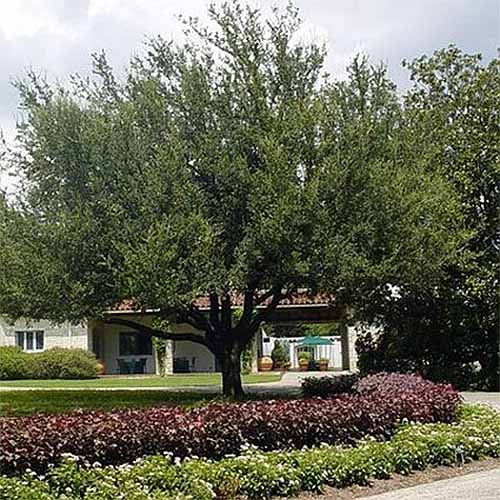
Southern live oak is available from Nature Hills Nursery.
It is also a habitat for other plants including Spanish moss, an image ubiquitous with the south.
If planted near a curb or sidewalk, the roots of the live oak will seem to “melt” over the stones; this is called thigmotropism and is an interesting feature of the live oak.
14. Tulip Popular
Tulip poplars (Liriodendron tulipifera) are some of the tallest trees in the eastern United States.
The tallest known specimen stands at 191 feet! They can put on up to 24 inches of growth per year.
Offering an attractive leaf shape and prolific flowering in the spring, tulip poplars are an excellent choice for shade in Zones 4 to 9.

Tulip poplars in #3 containers are available from Nature Hills Nursery.
They also stand proudly in any landscape, offering shade and towering authority. Tulip poplars do best in full sun where they are allowed to spread out and grow freely.
Their seedlings can sprout up around your lawn and around property lines, and probably in your neighbor’s yard, and their neighbor’s, and then their neighbor’s too!
Tulip poplars produce a mass of debris from flowers and branches to shed leaves. Watch for yellowing leaves in the summer, a sign of dehydration and then weakening of wood.
