


There are so many early spring weeds that we can’t cover them all here. However, we can help you ID a few and pull them before their root systems become established. Doing this ahead of spring’s peak makes it easier for emerging perennials to take off and thrive.
Not all weeds are invasive species, but some are. Thankfully, a consistent practice of removal can manage most of them. When they’re young, their roots are at what is called the “white thread stage”. This is when the root is not much larger than a small white thread. Pull them at this stage, and their re-emergence will be limited.
Not all spring weeds can be managed this way, though, and some require digging to remove their deep taproots. When you do this, try to get as much of the root as possible. Often, the plants resprout from root fragments left behind during the removal process.
Cleavers

Gallium aparinecommonly referred to as cleavers, is a common annual spring weed that has floppy stems with whorled leaves and tiny white flowers. They tend to develop bristles that cling to various things: animal fur, and notably, your pants. You’ve probably removed a cleaver or two if you’ve been gardening for a while.
This clinging allows cleavers to reproduce, as sections are discarded and tiny seeds are dispersed. These plants tend to grow in shady and moist areas, which are more common in early spring weather. They have a longstanding history of medicinal useand their plentiful nature lends to that history.
You can pull young cleavers early to prevent them from flowering and developing seed. For established stands, hoe them down, or use a shovel to remove them. Throw them somewhere where they can’t proliferate.
Henbit

Also called dead nettle, Embrace Lamius is related to purple dead nettle and has a similar botanical structure and habit. Both are common weeds with similar purple flowers. However, you can tell them apart by looking for the leaves that wrap around the stems. If these are present, you’re dealing with henbit.
While this plant can be beneficial to pollinators early in the season, it can form dense mats that take over garden beds quickly. If you want to support pollinators, focus your removal efforts on your garden beds and leave them elsewhere. However, note that powdery mildew tends to develop on the leaves, and this can be a source of the disease in your garden.
This is one of those early spring weeds that you can eat. The flavor is similar to celerybut slightly more peppery. To remove the plant, simply pull from the base. Remove the entire root to prevent continued proliferation.
Dandelions

The lovely Taraxacum officinaleor common dandelion, is a very common weed in early spring. It has sunny yellow blooms that form round, puffy seed heads, which free the seeds when they’re ripe. These are dispersed by the wind. The basal leaves are easy to ID as well. They are toothed and grow in a rosette formation.
What makes dandelions so difficult to remove is the number of viable seeds, plus the deep taproots that develop. You can easily remove young seedlings when the rosettes are just a couple of inches across. More established plants require a garden trowel or hori hori. If you can get the entire root out of the ground, that’s one dandelion down.
Dandelions are really hard to control, especially in disturbed sites like lawns and garden beds. Focus your efforts where your plants are growing. All parts of the dandelion are edible, and the dried roots make a lovely diuretic tea when they’re brewed with honey and lemon.
Chickweed

While it’s a lovely little plant, Stellaria mediacommonly called chickweed, is invasive along the eastern coast of North America. Identify it via its tiny white flowers that have deep divisions between the petals. These are surrounded by small, bright green oval leaves.
In Delaware, Pennsylvania, and Kentucky (among other states), removing this one is a good idea. And it’s fairly easy. Early spring weeds like chickweed tend to follow the “white thread” rule. Get it while it’s young, and you can likely eradicate the plant. The tiny seeds are super viable, so this will be a regular activity.
Chickweed and henbit, for that matter, are both beloved by chickens. You can let these grow in your chicken run to give your feathered friends some forage. Both are highly nutritious. Chickweed is also a non-native host for certain butterflies.
Lesser Celandine

Ranunculus would be was introduced to North America from Europe and the Caucasus long ago, and today it has naturalized across the continent. It’s a typical plant in floodplains and yards prone to flooding. It rapidly expands, aggressively colonizing natural areas. It will take over a space with ease and is difficult to remove.
To ID it, look for its bright yellow, eight-petaled flowers and its smooth leaf margins. There are native plants that resemble this one, but if you see these traits, you’re looking at celandine. Now is a good time to remove these early spring weedsbut pulling them isn’t your best option.
Instead, use a shovel to dig underneath the small mats and remove the plant, small tubers, and all. Any tubers left in the soil will continue to proliferate, so repeated removal is your best option. After you remove these weeds, plant something else that forms dense mats to prevent re-emergence.
Horseweed

Known botanically as Erigeron canadensisthis tall-growing weed is at a small stage in spring. It’s an inconspicuous plant that forms small rosettes of green leaves. These are very easy to pull at any stageand the plant does not reproduce via its roots. So this is one of the early spring weeds that is not hard to remove at all.
The difficult aspect of horseweed has to do with its numerous and highly viable seeds. It can take over natural areas, and while it’s native in parts of North America, it can be very aggressive. If one goes to seed in your garden, you’ll likely see tons of seedlings next spring.
The flowers of horseweed feed pollinators, and the stems house solitary bees. I tend to let a few of these grow each year and suffer the consequences. But here in North Texas, these are important plants. The leaves are also edible and provide a flavor profile akin to oregano.
Common Groundsel
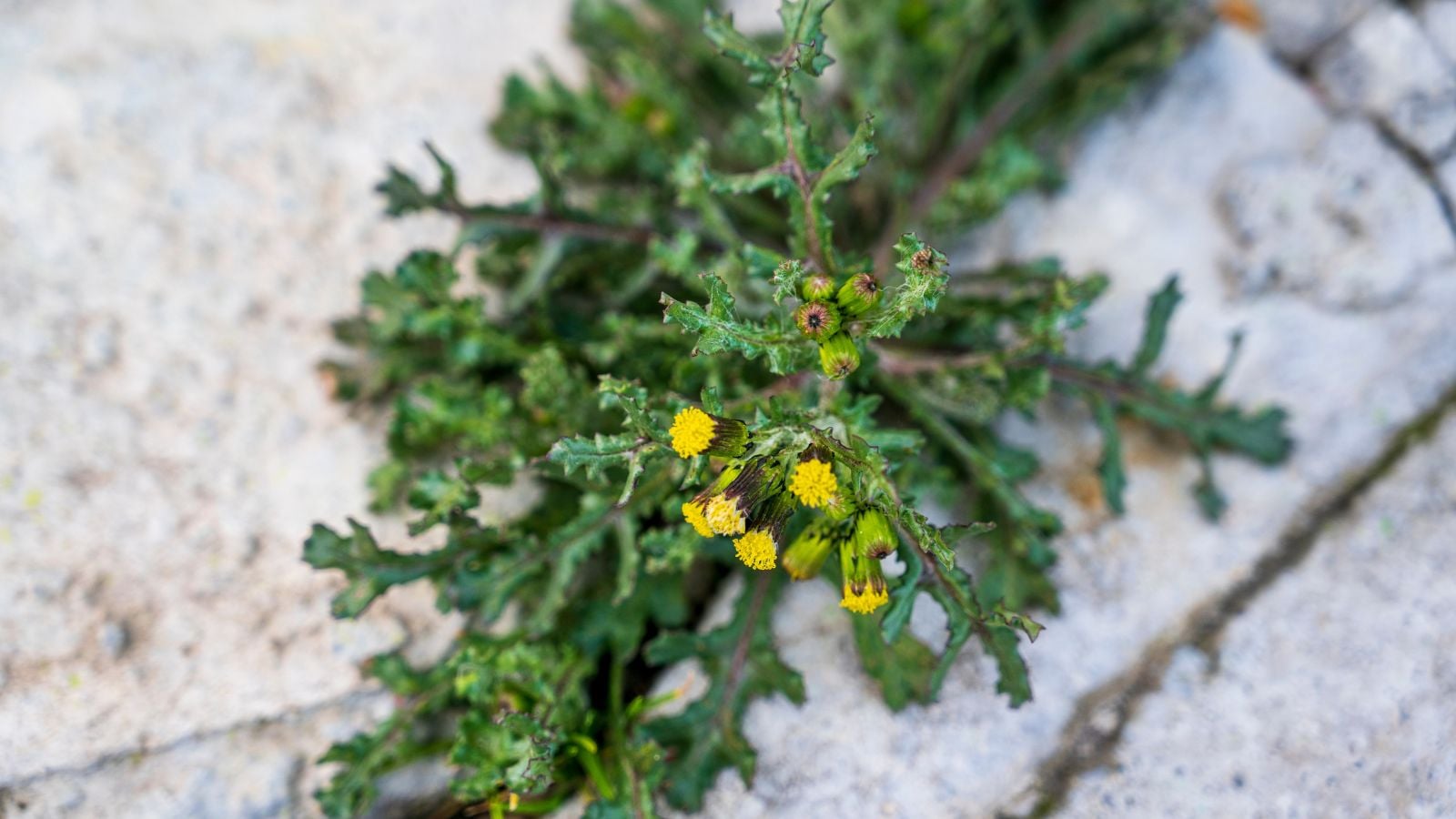
Among early spring weeds, Senecio vulgariscalled common groundsel, is a regular sight. It is common in vegetable bedsand thankfully has a distinct appearance compared to other plants. You can ID it via its lobed, lance-shaped leaves that have a rough, almost hairy texture. Like dandelions and horseweed, it’s a member of the aster family and produces puffy seed heads.
And like its relatives, the seeds are plentiful and viable. This is its most common method for spreading, as the small yellow flowers fade and make way for wind-dispersed seed. It often enters gardens via nursery pots, so inspect those for this plant before planting them in the ground.
In early spring, it’s easy to pull these weeds by hand and throw them away. Do this before the flowers open for the best results, or be prepared to consistently pull. You can also heavily mulch cultivated areas to smother young seedlings before they mature.
