


This year, I’m finally confident enough in my garden to admit something out loud:
I think my rhubarb is established.
Which means I can now reasonably justify trying to force it.
Forced rhubarb, for the uninitiated, is harvested earlier than usual and prized for being sweeter, more tender, and almost jewel-toned in color. Grown without light, the stalks never develop chlorophyll, which is why forced rhubarb is paler, sweeter, and less fibrous than its field-grown counterpart.

It’s grown in total darkness, which immediately appealed to me—not just for the horticultural intrigue, but because it offers a long-awaited excuse to indulge a very specific object of desire: terracotta rhubarb forcers.
To do it properly, the crowns are covered and kept away from any light. And if you want to be truly traditional, you harvest by candlelight, at night.
That detail alone was enough to win me over. Gardening is rarely improved by rules, but it is occasionally improved by romance.
A Brief Detour to Yorkshire
In 2010, Yorkshire Forced Rhubarb was awarded Protected Designation of Origin (PDO) status by the European Commission—a distinction I deeply admire for its ability to honor local agriculture and tradition.
The famed “Rhubarb Triangle” is a nine-square-mile area in West Yorkshire, bordered by Wakefield, Morley, and Rothwell. For generations, it’s been known for producing early forced rhubarb, harvested in the dark winter months and carried out by hand.
Before World War II, when rhubarb was immensely popular, these fields were fertilized with generous amounts of horse manure and something far less poetic-sounding: night soil.
Yes. I looked it up too.
Night soil is a euphemism for human waste collected from privies and cesspools and used as fertilizer. The collectors—called gong farmers—were only allowed to work at night, and the waste had to be removed beyond city boundaries. In Manchester, they were also known as Midnight Mechanics.
I’ll let that settle for a moment.

Objects of Obsession
Back to the forcers.
There are some handsome antique and reproduction rhubarb forcers available online, but the truly beautiful ones are handmade. John Huggins, a British pottermakes classic terracotta versions and—dangerously for someone like me—also teaches something called ‘The Big Pot Class‘.
Held annually in August, the class teaches potters how to make very large vessels. Students can leave with up to ten pots after a week of work, which, at £325 plus materials, feels like a remarkable bargain if you’re inclined toward big ideas and even bigger containers.
I’m not saying I need ten oversized pots.
I’m just saying I understand why someone might.
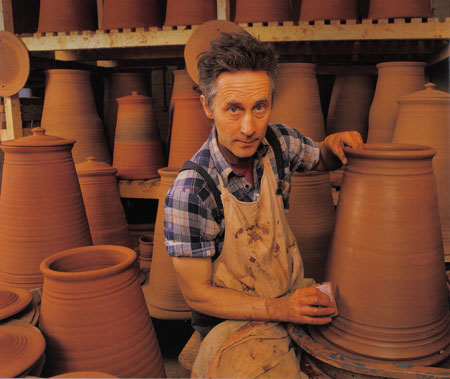
The Big Pot Class
Offered by John Huggins of Ruardean Pottery

Why This Matters (More Than It Should)
Rhubarb forcing sits at a strange and wonderful intersection of food, seasonality, labor, and ritual. It’s impractical, specific, and deeply rooted in place. It requires patience, darkness, and a willingness to care about something that most people barely notice.
Which, of course, is exactly why it’s compelling.
In a world obsessed with efficiency and abundance, rhubarb forcing feels deliberately inefficient—a practice rooted in patience, restraint, and seasonal scarcity.
This isn’t about needing earlier rhubarb. It’s about leaning into the odd and choosing to participate in a tradition—however impractical—that connects food, place, labor, and time.
Even the slightly unhinged ones.
Keywords:
- agricultural traditions
- seasonal rituals
- historic food practices
- kitchen garden culture
