


Turn your senses into powerful gardening tools by observing plants, tracking patterns, and understanding microclimates for healthier, more resilient gardens.
Precision Gardening: observation, record-keeping, and intuition
I was at a client’s garden recently, discussing soil moisture in a raised garden bed. I watched her try to calibrate her soil-moisture app. She was looking at her sleek digital probe, squinting at numbers glowing on her phone. I took my glove off and pressed my finger deep into the soil.
Before I’d even used my finger probe, I already suspected it was very dry. I had my invisible detective hat on, visually following a trail of clues and examining other evidence in that garden bed. Firstly, the plants themselves were beacons of distress I couldn’t miss. The young leaves of many leafy greens were drooping, and the older leaves showed multiple nutrient deficiencies, often a sign of water stress.
Next, I noticed only a thin layer of mulch, providing minimal protection, and no evidence of a drip system, soaker hose, or irrigation. My client was watering manually with a hose, and I suspected it was not often enough. I knew the weather had been hot, dry and windy for weeks, adding abiotic stresses to the mounting clues. There were also indications of pest and disease problems on the weakened plants.
I’d only just begun my observations, but there was enough data to tell me there were bigger problems than just dry soil. It was useful to know her digital probe confirmed my assessment of only 20% soil moisture. However, a single tool couldn’t detect the other clues I’d spied and the domino effect they were having on her plants.
Measuring Apps vs Personal Observation
Technology can measure, but it can’t notice. Human observation, on the other hand, builds a knowledge base that’s slow, contextual, and uniquely suited to each garden.
That experience sums up a bigger truth I’ve come to realize: the most advanced gardening tool we have is attention. Precision is more than sensors, subscriptions, or Bluetooth connections – it must be cultivated.
The best data is gathered by looking closely at little details, taking photos, recording notes, and joining the dots, one aha-moment at a time. These pieces of the puzzle gradually reveal themselves until we get a sense of the bigger picture. I think of it like following a trail of breadcrumbs that leads us to make more informed decisions. It’s actually quite fun.
My version of precision is knowing what’s happening, not because an app told you, but because your senses did.
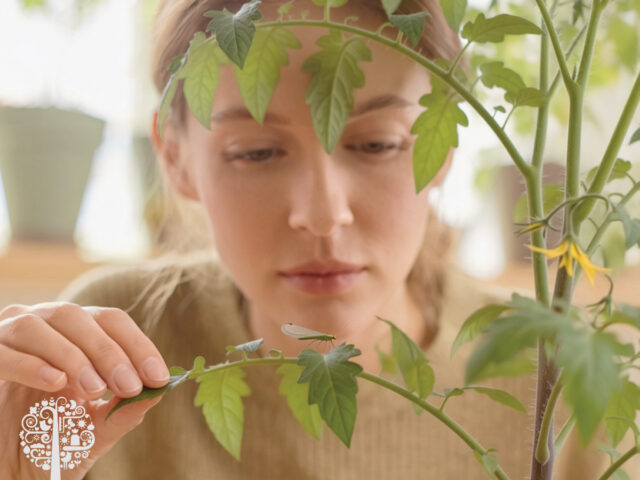
Treating the Garden as a Living Laboratory
Whilst not a soil scientist, I love experimenting in my garden ‘lab.’ It’s a place where observations over seasons evolve into valuable data. Unique to each of us. We begin to see the cause-and-effect patterns that hide in plain sight, like:
- the lettuce and rocket that bolt after a day of intense heat and low soil moisture;
- the crops that burst into flower after liquid feeds; and
- the accidental discoveries of plants that grow when they’re not meant to.
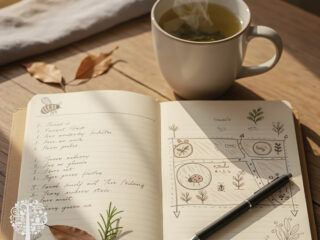
I keep a Garden Journal – a diary of seasonal notes. Some days it’s a proper record of dates, rainfall, pest arrival, transplants, weather observations, fertilizing, and seeds sown. Other times it’s a confession: “I neglected to water the beans and spider mites arrived again.” After a few seasons of noticing the same patterns with plants, weather, and insects, I can start predicting instead of reacting. It’s an empowering feeling.
Just this morning, as I inspected the cucumber plants on my daily health check to see if there were any ‘patients’ requiring diagnosis or a remedy, I spied two ladybird species. One was a clue that aphids were hiding under her leaf; the other was dining out on powdery mildew. Their presence prompted me to look more closely. Upon further investigation, I noticed frass on another leaf. Looking up, I knew the culprit must be feeding above. Sure enough, a curled leaf disguised the caterpillar hiding at the scene of the crime. The insect pressure prompted me to address the cucumbers’ nutritional needs.
These insights, driven by curiosity, have helped me identify many insects over the years that I would otherwise have missed. I admit, I’ve used a magnifying phone app for tiny insects and taken photos of species to help with identification – both helped by technology. However, technology can’t see the different insect species flying around or on my plants. It’s up to me to notice who’s in residence. What plants they’re visiting or damaging, what they look like, and when they appear. That data helps me detect seasonal or species-related patterns.
Microclimates for Precision Decision-Making
My garden is a patchwork of diverse microclimates. A wind-protected sunny courtyard; exposed terrace gardens that take the brunt of wild winds, intense summer sun, and storms; shaded nooks that leafy greens love, and many more. In different climates, other gardeners might notice where frost hits hardest or where snow melts first.
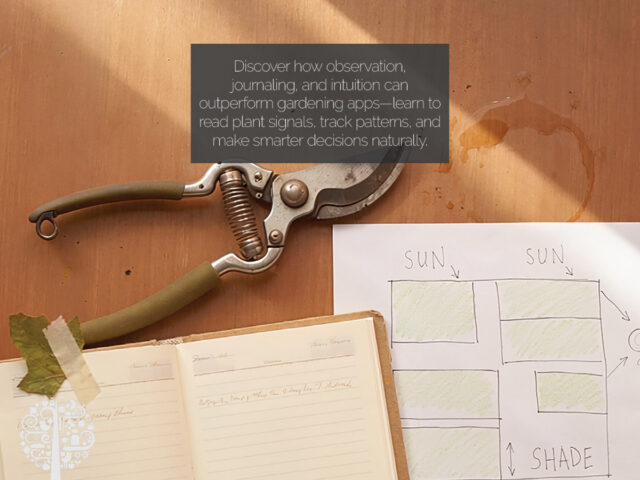
A practical exercise I use is to spend 10 minutes or more each season in each corner of the garden at different times of day, snapping photos and taking in the environment. I’ve discovered more data that way than any algorithm could tell me. With pen and paper in hand, I watch where shadows and sunlight fall, insects or animals that visit, and wind direction. Little details matter. I’ve mapped my microclimates with a simple sketch – it’s been a data-rich planning and design tool.
This fine-tuning exercise has enabled me to select the right plant for the right place, no guesswork – just prior knowledge. I match them to the microclimate that best suits their needs, and they thrive as a result. This data is gardener’s gold.
Water Wisdom – Reading Plants Like Weather Instruments
I’ve watered my gardens using timers and sensors that manage drip irrigation systems. They’re convenient and time-saving, but there’s an art to watering that is lost when we outsource to equipment. We miss the deeper connection to individual plants – their silent language that tells us exactly what they need. Too much or too little – or too late!
There’s an intimacy to watering by hand – it feels like a slow-motion conversation. While I water, I watch. I notice which plants perk up first and those that hold grudges. Like Mr. Droopy in my lounge room – he has a big personality. He throws a tantrum when I forget to water his pot by the sixth day. He wilts and leaves start to curl or brown, warning me his companions in the same room are only a day or two behind. I dash out to give them all a good soak before there are any more complaints. Plants become our living barometers, leaving clues through their leaves for the garden detective.
Plants have a language of their own – wilting, browning, looking dull and neglected – their way of quietly getting our attention. Precision watering isn’t done with a timer – it starts with noticing the signs of when thirst begins. We won’t always get it right. Plant parenting doesn’t come with a rule book! I experiment with watering, observing how plants respond and adjust to their schedule.
The Precision of Patterns and Building Consistent Habits
I’ve got into the habit of consistently making daily observations in the garden – same time, same place, and plants. I compare photos each year of the plants, insects, and seasonal observations. It’s an easy way to identify recurring patterns year over year. This habit has helped me build our internal ‘database’ based on photographic evidence and intuition.
For example, when I moved from a temperate to a subtropical climate two decades ago, I had to learn new climate patterns and when to plant. As I began keeping records, I noticed our region appears to have five seasons rather than four. I maintained my observations of recurring patterns for many years until I had sufficiently accurate data to create a seasonal planting guide. It’s proven to be a valuable tool not just for me but for hundreds of local gardeners. I later learned my analysis aligned with indigenous seasons.
The more frequently we make it a habit to watch the goings-on in our garden, the more accurate our sense of when to sow, prune, or wait becomes. In a way, we tune our brains to the garden’s frequencies to connect the dots, detect changes, and track seasonal rhythms.
Choosing Your Cast of Characters
Plant varieties are like actors: some follow the general script, others improvise wildly depending on the soil stage. It pays to keep track of your cast. Which plants are your star performers? Who are the flops? I’ve found it’s often the self-sown wild tomato adapted to my soil conditions that performs best compared to those I raise painstakingly from seed!
Generalized data in apps, books, or blogs may recommend unsuitable varieties for your unique microclimates. I’ve found it incredibly useful to keep a record of the best crops and to create a personalized database that accounts for local conditions.
Knowing What to Stop Doing
I’ve also realized that, regardless of how incomplete or fallible our notes, journal or observations are, our personalized data is more accurate and reliable than any algorithm or app. That’s because our onsite experiences are localized to our unique space. We know precisely what is planted, when, how, and so much more. We know cause-and-effect relationships from our garden experience. An app can’t possibly discern context.
Sometimes we need to eliminate what’s not working. My observations have been key to avoiding mistakes. On several occasions, I fertilized spring onions and chives with too much nitrogen. Each time, the following day, without fail, onion aphids arrived in droves. I created the problem and needed to stop that pattern. I switched to an alternative fertilization method, and the aphid population declined. I had the data but failed to use it. Patterns are powerful intel. Sometimes we need to stop doing what doesn’t serve us.
Many of us feel we have enough tech in our lives. Disconnecting in our garden is one of the ways we recenter ourselves, find peace, unplug from the noise, and learn to listen to nature’s wisdom. Our eyes are the most powerful lens for seeing our gardens. Sure, use an app to identify an insect you’re unfamiliar with and learn who’s visiting your plant and what clues it might be to their presence. I believe that true precision, though, doesn’t come from gadgets, but from human attention refined over time. Spending time noticing what’s new in our gardens and reconnecting with our plants at a deeper level is exceptionally rewarding.
Try putting your detective hat on next time and see what hidden discoveries you find. There are mysteries to be solved and nature’s fingerprints to investigate as you read between the leaves to decipher plant and soil health. I may be old-fashioned, but for now, I’m sticking to my finger probe, seeing my garden through my own lenses and journalling my daily data observations. It takes precision gardening to a whole new level.
