


7. Lisa
This pitaya’s name is ‘Lisa,’ but we might as well call her Mona Lisabecause this variety’s fruits are works of art.
A cultivated variety of S. monacanthus, this Nicaraguan type bears one of the most attractive pitaya fruits out there – these have thick red skin and curling green bracts that have striking, dark red margins.
And with ‘Lisa,’ the beauty isn’t only skin deep.
The flesh of this cultivar is a rich, dark red hue and the taste both sweet and acidic, making it extremely flavorful. ‘Lisa’ has been rated with a Brix score of 18.
In fact, in a blind taste test conducted at the University of California at San Diego Cooperative Extension‘Lisa’ received one of the top rankings among pitaya cultivars for flavor.
Not only does ‘Lisa’ have great flavor, its flesh has a pleasantly smooth consistency, packed in oval-shaped fruits that weigh in at one pound each.
The flowers of ‘Lisa’ are self-sterile, requiring cross-pollination, and plant stems have a grayish coating that contributes to this plant’s increased heat and cold tolerance.
‘Lisa’ is ready to harvest between June and January.
8. Physical Graffiti
Like the Led Zeppelin album this hybrid is named after, ‘Physical Graffiti’ is prolific and impressive.
A cross of S. guatemalensis and St. wavedthis pitaya cultivar has bright, pinkish-red skin that is fairly thin with green bracts.
Its flesh is light purple to magenta and it has excellent flavor, with a Brix score just under 18.
Fruits are oblong and medium to large, weighing up to a pound and a half each. They’re produced from flowers that are self-sterile and require a red-fleshed variety as a pollinator, so choose one of these to plant nearby.
Plants thrive in full sun and are vigorous and productive, with improved tolerance to both heat and cold.
But just like a guitar solo that goes on a little too long‘Physical Graffiti’ is a bit aggressive, and this variety will require a bit more pruning than others.
(Yes, sometimes it is possible to have too much of a good thing – but that’s okay, with this cultivar you can plan to give cuttings to your friends!)
‘Physical Graffiti,’ the pitaya, is harvested from July to December.
Here’s the perfect pastime for listening to your favorite Led Zeppelin albums – pruning your own dragon fruit plant while you rock out.
9. Purple Haze
Have you noticed a trend in where pitaya hybridizers must find their inspiration for naming their creations?
Not yet?
Well, let me introduce you to our next variety.
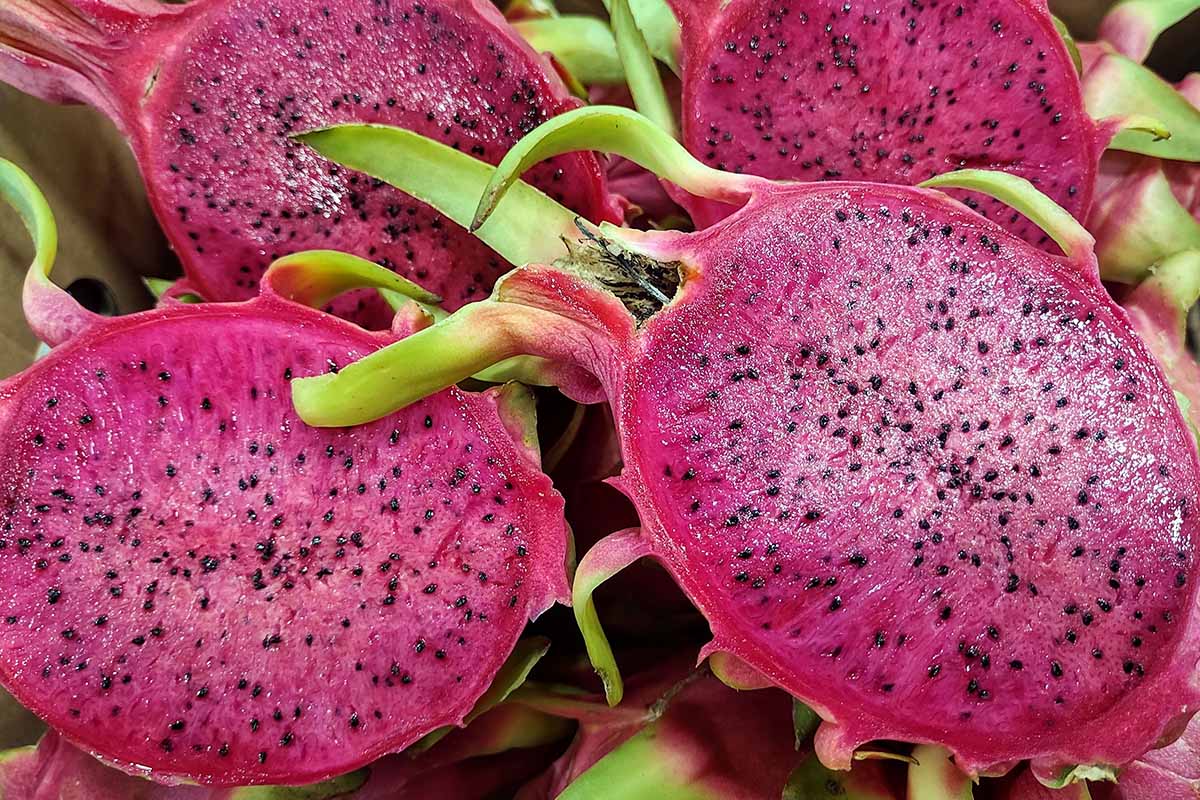
‘Purple Haze’ is not just one of the most well-known Jimi Hendrix tunes, it’s also a fruit you can eat.
A hybrid of S guatemalensis and St. wavedthis pitaya hybrid has pink skin with green bracts, and contains purple flesh.
Its purple pulp is very sweet with hints of grape and kiwi and a Brix score of 19, enclosed in oval-shaped fruits.
These dragon fruits are large, weighing in at one to two pounds each, and born from self-sterile flowers that require cross-pollination.
Like our previous hard-rock-inspired selection, ‘Purple Haze’ grows aggressively, so make sure you have a good pair of pruners.
10. Sugar Dragon
Departing from iconic rock and roll references, our next pitaya variety is known for its high fruit production and ability to serve as a cross-pollinator.
‘Sugar Dragon’ is a cross of S. guatemalensis with an unknown species.
This cultivar has red skin with small, greenish-brown bracts enclosing semi-firm, reddish-purple flesh.
Its pulp has excellent flavor with rosewater or berry undertones, and it is sweet, with a Brix score of 18 or higher.
