


Bleeding Heart Vine makes a charming house plant. Eye-catching red and white flowers cover this vine from spring to fall. Find out how to grow, when to fertilize, plus pruning and year-round care.
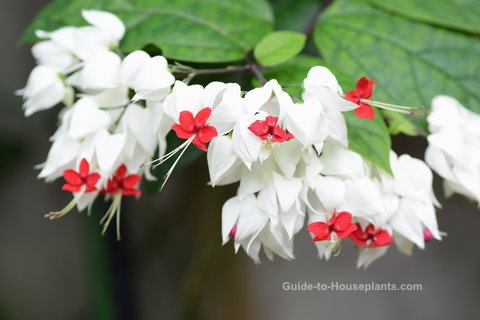 Clusters of gorgeous blooms decorate Clerodendrum thomsoniae.
Get to Know Bleeding Heart Vine
Known botanically as Clerodendrum thomsoniaebleeding heart vine makes a beautiful flowering house plant. Train it on a trellis, let it trail from a hanging basket, or prune it back — you can grow this tropical vine any way you like.
This tropical beauty is covered with attractive deeply veined, ovate leaves. Its glory, however, are the eye-catching red and white flowers that bloom profusely from spring through fall. Made up of snowy white calyces, the blooms are somewhat heart-shaped. Emerging from each calyx is a bright red flower with long stamens.
Even young plants are eager to bloom, making this a must-have houseplant; that is, if you can meet this tropical plant’s needs.
Its native habitat of Tropical West Africa tells us how to care for this gorgeous houseplant. Bright indirect light, warmth, and high humidity will make it feel at home indoors.
How big does bleeding heart vine get? Its vines will grow 6 ft (1.8 m) long or more if not pruned back.
You’ll find this stunning vine for sale at nurseries and online in spring and summer. It’s usually known as Bleeding Heart Vine and sometimes as Glorybower. Look for the botanical name Clerodendrum thomsoniae to be sure you’re getting this plant.
As if this plant isn’t showy enough, a variegated variety exists. C. thomsoniae “Variegatum” features marbled green leaves that are truly spectacular.
Caring for Bleeding Heart Vine Year-Round
Repot in spring only when it has outgrown its container. Bleeding heart blooms best when it is slightly pot-bound, so move it up to a pot only 1 size larger. Use a pot with drainage holes to prevent soggy soil.
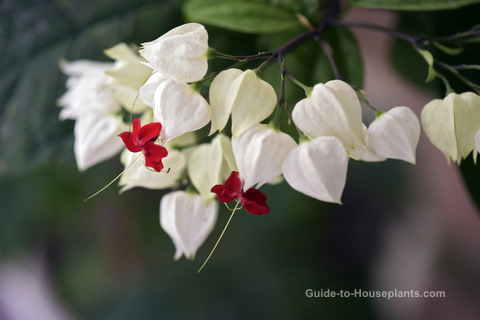 Clerodendrum thomsoniae makes a stunning flowering houseplant.
Prune vines back in spring, when bleeding heart vine is beginning new growth. Flowers grow near the tips of new stems, so you’ll get more blooms this way. You can cut the vines back by as much as half, if you want, to keep the plant at a manageable size for growing indoors.
Pruning Tip
Always prune above a leaf node (the place where a leaf is attached to the stem). Use sharp, clean pruning shears to avoid jagged tears and disease.
Raise the humidity if the relative humidity near the plant drops below 50%. You can place the pot on a tray of wet pebbles. Or use a cool-mist room humidifier. Raising the humidity also helps to prevent spider mites from invading. Watch for these pests, especially in winter when indoor air tends to get dry.
Give it a winter rest. This tropical vine is an evergreen perennial, but it may stop flowering in the fall and winter months and growth slows down. Unlike the popular shade-loving Bleeding Heart Plant, this vining plant won’t overwinter in the garden, unless you live in a tropical climate. Give it warmth, humidity and bright, indirect sunlight year-round. Water sparingly during this rest and stop fertilizing till spring when you see new growth on the plant.
Bleeding Heart Vine Care Tips
Light: Bright indirect light. Bleeding heart is a prolific bloomer when it gets enough sunlight. It blooms heavily in spring and summer. If it doesn’t bloom much, move it to where it will get more light from a south- or west-facing window.
Water: Keep soil evenly moist spring through fall, while bleeding heart vine is growing and flowering. Water sparingly in winter, but do not let it dry out completely.
Humidity: Aim to maintain 60% humidity — or higher — around the plant year-round. This is easier than it seems; set the plant on a pebble tray or use a cool-mist room humidifier. It’s a good idea to use a humidity gauge rather than guess — air can become extremely dry indoors during the winter months.
Temperature: Average to warm (65-85°F/18-29°C) year-round
Soil: Good-quality potting mix
Fertilizer: Feed every 2 weeks in spring and summer with a high-phosphorus water-soluble fertilizer.
Propagation: Easy to propagate from stem cuttings. Take 3 in (8 cm) stem tip cuttings in spring and root in equal parts all-purpose potting mix and perlite.
