


You can count on Meyer lemon tree to produce an abundance of sweet lemons every year, with good care.
Here you’ll discover how to grow dwarf Meyer lemon trees indoors with tips for watering, fertilizing, and how much sunlight it wants.
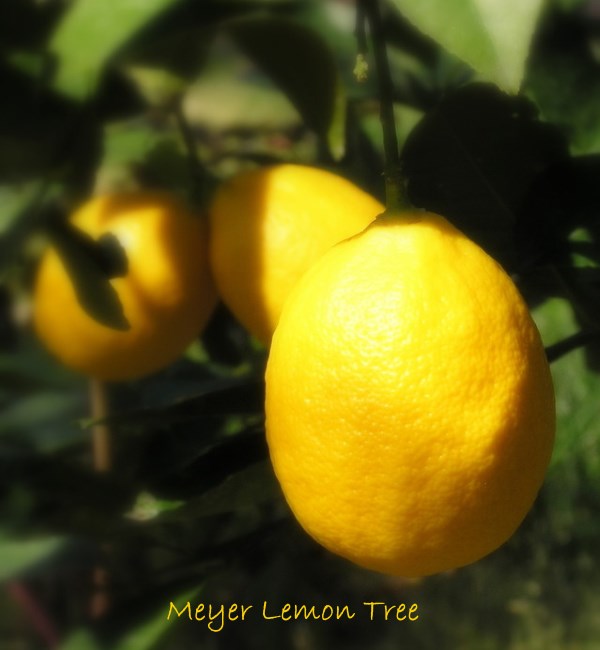
Get to Know Meyer Lemon Tree
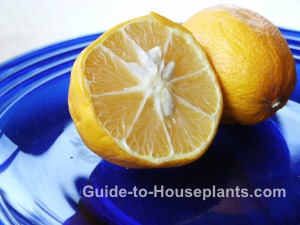
Known botanically as Citrus limon ‘Meyer’, this perennial shrub is actually a cross between a lemon and a mandarin orange. The fruit is rounder than a true lemon, with a thinner skin. It is also sweeter and less acidic, making Meyer lemon a favorite among cooks.
The woody stems of this dwarf citrus tree are densely covered with oval, glossy green leaves.
You can expect clusters of small, white flowers to appear in late winter and spring on Meyer lemon trees that are 3-4 years old. Highly fragrant flowers are followed by fruit that turns from deep green to bright yellow as it matures.
Did you know…
Meyer Lemon Tree gets its name from Frank Meyer, a USDA employee who discovered the dwarf citrus tree growing in China and brought it back to the U.S. in 1908.
By the 1940s, Meyer lemons were commonly grown in California. Unfortunately, the trees became carriers of the citrus tristeza virus and were destroyed.
In the 1970s, a virus-free selection: Improved Meyer lemon tree (C. limon ‘Improved Meyer’) was offered to meet the demand for growing these sweet, juicy lemons at home.
Special Helps for Your Indoor Meyer Lemon Tree
Shed some light. Indoor citrus trees need as much light as you can give them. Place your plant directly in front of a window where it will get several hours of direct sun each day. You can move it outdoors for the summer, if you want. Just be sure to bring it back indoors before the first frost.
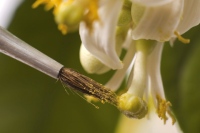
Pollinate your plant. A lemon tree that is grown indoors will need to be hand-pollinated to trigger fruit production.
Use a small, dry paintbrush to dab each flower. Wiggle the brush around the center of each flower, moving from flower to flower. This carries the pollen from male to female flowers, just like bees do it.
Prune branches. You can maintain an attractive shape for your Meyer lemon tree by pruning long branches. The best time to prune your tree is when new growth starts in spring. Pruning citrus trees’ long branches will encourage new branches to emerge from just below the cut. Cut at an angle just above a leaf node (where a leaf stem attaches to a branch). Try to avoid cutting off branches with flower buds or flowers if you want the tree to produce fruit.
Repot young plants every 2 years, moving them to a pot no more than 2-inches (5 cm) larger than the old pot. Citrus trees won’t bloom well if they are over-potted.
Watch for bugs. Scale insects may invade citrus trees. Look for these brown, round-shaped insects on the leaves and stems. You may be able to pick scale off by hand; if they are difficult to remove, try loosening them by dabbing scales with a cotton swab dipped in vegetable oil.
Buying Tip
Buy a Meyer lemon tree from a reputable grower to ensure it will produce fruit. I recommend dwarf citrus for indoor growing because it only reaches about 6 ft. tall.
Meyer Lemon Tree Care Tips
Origin: China
Height: Up to 6 ft (2 m)
Light: Full sun. Turn the plant a quarter turn every week to give all sides equal light for good growth. You’ll get more flowers on your lemon tree if you put it outside for the summer and fall. A few months of hot, sunny days followed by cool fall weather will promote flowering.
Water: Water thoroughly, allowing the surface of the soil to dry between waterings.
Humidity: Average room (around 40% relative humidity). The most efficient way to increase humidity is to use a cool-mist room humidifier near the houseplant. Dry indoor air can cause flowers to fall off without growing fruit.
Temperature: Warm room temperatures (65-80°F/18-27°C) are ideal year-round.
Soil: Well-draining potting mix works best for citrus trees. Use a peat moss-based mix with added perlite and/or vermiculite.
Fertilizer: Feed every 2 weeks in spring and summer. I highly recommend organic fruit tree fertilizer. It contains all the nutrients citrus trees need for healthy root growth and promotes flowers and fruits.
Propagation: Take stem cuttings in early summer. With a sharp knife or razor blade, take 4 in (10 cm) stem tip
cuttings with at least 2-3 leaf nodes without flowers or fruit. Dip cut end in hormone rooting powder before inserting
in moist potting mix, then enclose in a plastic bag to maintain humidity. Stem cuttings will root in about 6-8 weeks.
