


For years I have wondered why Europeans find American prairie planting so aspirational, while Americans will go to great lengths to create a semblance of Northern European gardening (often referred to as English) in the US. Can it be as simple as “the grass is always greener”? On researching locations for Gardenista: The Low-Impact GardenI had a call with plantsman Jack Pizzo, who lives on 40 acres of restored wetland prairie, an hour west of Chicago’s O’Hare Airport. During that conversation he said that with all the choices we have, human landscaping is chaotic. Restoring an ecosystem, on the other hand, involves following what the natural landscape is telling you. Fewer choices, less need to control, less chaos: I had found the key to the book. My actual visit to Jack’s prairie garden, with the photographer Caitlin Atkinson, was quite a trip.
Photography by Caitlin Atkinson for Gardenista: The Low-Impact Garden.
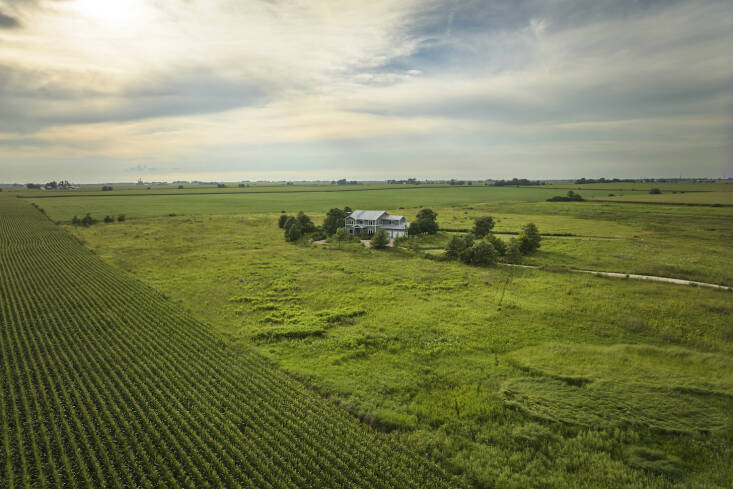
Having been briefed to travel all over the States—south, west, and points in between—I found myself thinking about the Alfred Hitchcock film North by Northwest while driving down a long, straight highway, between long, straight lines of beans and corn. A crop duster plane flew toward us as we ducked off into a curved driveway through prairie grassland. Spraying on the neighboring farms takes place on still days, when chemicals will not drift over the boundary and be wasted.

A bona fide American prairie, at last. Jack’s academic background is in ecology, and he is actively passionate about planting for birds. He’ll plant an American hazelnut with the hope of attracting the brown thrasher (successful); he creates open spaces and puddles to attract the golden plover. A farm puddle is a “fuddle,” and traditional (pre-industrial) farms would have incorporated more of these relaxed spaces. Jack is re-forging relationships between animals and people, since any prairie, meadow or grassland, is made and maintained by people.
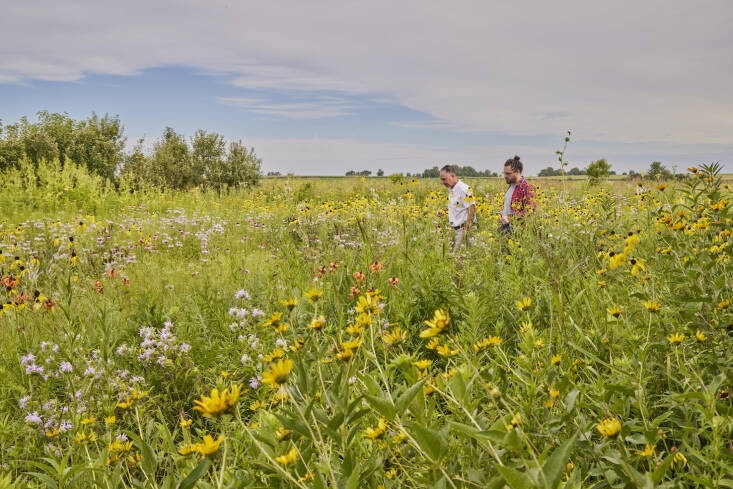
The day of our visit was very hot and humid and I was given some Wellington boots to swoosh through the grassland that surrounds Jack’s house. “You can wander anywhere, there are no paths,” he told us. The plants bounce right back after trampling: “Be like bison; walk side by side.” The ground is damp since this is restored wetland, which was never particularly suitable for straight farming.

Jack’s prairie is simultaneously a garden and a farm. He is a farmer amid other farmers because he grows native plants and distributes their seeds through his land restoration business. He rails at being called a landscaper for the reasons mentioned above: in restoring the land, a natural pattern and logic has been able to emerge, and it’s about habitat. To this end, he has seen 170 bird species in the garden and nine species of amphibians and reptiles. In amongst the 250 native plant species, there are at least five different roses: Carolina, Illinois, swamp, tall pasture, and Arkansas rose. Seven types of milkweed (whirl, common, swamp, butterfly, mountain, green, and green-horned) attract monarch butterflies that rest here in their hordes, en route from Mexico.
