


Discover how Hash Bash helped drive cannabis legalization in the U.S., from counterculture protests to mainstream acceptance and legal reform.
Major social change often needs a spark, and cannabis legalization was no exception. Cannabis, once counterculture, is now mainstream—but that shift only came after intense government crackdowns triggered public pushback.
In the late 1960s, the rise of the counterculture, opposition to the war, and civil rights activism set the stage for social change in America. People were looking for a better way. American propaganda pointed to cannabis as one of the most dangerous drugs around. Yet the Eastern influence and counterculture movement were proving the opposite.
Music and Cultural Uprising
Music has always fueled social change, and cannabis has long been intertwined with musicians and creativity. Often, music has been the catalyst for the change needed for positive growth. From the Celts to the American slaves singing about how to get out of the American South, you can find music guiding people through hard times.
The Sinclairs and the Birth of Activism
The late 60s saw the rise of the Black Panthers and bands like MC5, who helped fuel activism from Detroit. Activists John and Leni Sinclair used music and protest to advocate for cannabis and civil rights, drawing attention from authorities. The Sinclairs started the Detroit Artists Workshop. The idea was to help artists with housing, printing, and performance space. They also allowed open cannabis use, which prompted raids on Marijuana charges. Upon Leni’s release, she threw a party and invited the MC5. The Sinclairs saw their potential, and John became their manager.
Building the Movement: White Panthers and MC5
MC5’s outspoken music promoted activism and challenged listeners to join the movement for change. Working with the Black Panthers, the Sinclairs and a friend launched the White Panthers movement to help fight with the Black Panthers in solidarity against the ongoing racism, war, and corporate greed. The Sinclairs were also strong advocates of cannabis reform. Utilizing radio, poetry, concerts, and underground newspapers to help voice the new ideas, the movement began to gain traction quickly.
The FBI was already watching the Black Panthers closely. During that time, John offered an undercover narcotics agent two joints, and the cops raided the Music Workshop again. While out on bail, Sinclair organized the MC5 to play at the Democratic National Convention in Chicago. Their ‘Love In’ at Belle Isle Park led to riots that saw 150 cops come in on horseback.
Legal Battles in Ann Arbor
Eventually, the Sinclairs moved their operations to Ann Arbor, Michigan. Being in a new upscale college town came with the advantage of lax cop presence. It also caught John a conspiracy charge claiming members of the White Panthers plotted to blow up a CIA building. Sinclair’s group fought the legal battle all the way to the Supreme Court, and the charges were dropped due to illegal wiretapping. The ruling set a standard that even a sitting U.S. President couldn’t avoid, and the effect of that case changed the course of the American government forever. That’s when the charge for the two joints caught up.
The Free John Sinclair Movement
This time, the drug charge was extreme, and John found himself sentenced to ten years for those two joints. The case gained international attention as Leni helped rally ‘Free John’ events. As the movement gained traction, celebrities began fighting for the cause. In December of 1971, the Freedom Rally at the University of Michigan brought together 15,000 attendees and featured John Lennon, his wife Yoko, Bob Seger, Stevie Wonder, and others, calling for the release of John Sinclair. Lennon came out and sang his song ‘John Sinclair’ to help raise awareness.
Victory and the Birth of Hash Bash
By the next year, Amsterdam had launched the first-ever cannabis cafe, and the times were changing. Michigan overturned John’s case and the existing cannabis laws, releasing him from prison.
For a 22-day window, cannabis was legal in the state of Michigan. When the state decided cannabis was set to be illegal again, the people came together to protest with a smoke-in at the U of M. That protest became the first Hash Bash.
Ann Arbor: A Hub for Reform
The event grew very large, causing tension between the people and the government. The city of Ann Arbor made cannabis a civil infraction and only charged a small fine for possession if caught.
Growing the Tradition: Hash Bash in the 70s and 80s
Ann Arbor became a cannabis hub, inspiring similar reforms nationwide. Hash Bash became an annual celebration and protest for drug law reform hosted on the U of M Diag every April 1st throughout the 70s. The protest for marijuana reform at Hash Bash grew and attracted more and more people, but during the 80s, the attendance started to drop. In an attempt to revitalize things, High Times Magazine and former head organizer Adam Brook became involved.
Revival and Expansion in the 1990s
In the 90s, renewed activism and media coverage revitalized Hash Bash, with John Sinclair returning to the spotlight. Eventually, it was decided that the event would be held on the first Saturday in April.
Expanding Activism and the Internet Era
As the movement continued forward, public figures like Jack Herer and Ed Rosenthal became more involved. The Internet was formed. Canadian activist Marc Emery started an underground seed and clone trade online, while spreading the word to “overgrow” the government. Places like Rainbow Farms hosted festivals that promoted open cannabis use and held open farmers’ markets with live music. People taught each other growing techniques, swapped incredible cannabis genetics, and the scene was booming. Many Hash Bash speakers also spoke at Rainbow Farms.
The farm eventually caught the attention of local authorities, who raided it. It ended in tragedy when the FBI came in during a standoff and shot the owners. The tension from the event only fueled the flames for cannabis reform, and the movement continued to grow.
Medical Cannabis and 21st Century Progress
With medical legalization in states like California, Hash Bash and the movement grew stronger. The 2000s brought Canadian medical cannabis and new varieties to the U.S. market.
Michigan legalized medical marijuana in 2008, expanding patient care options and spreading awareness.
- Pushing for Full Legalization
By 2012, Hash Bash focused on full legalization, with thousands attending and MI Legalize forming by 2015.
Live music became a new tradition at Hash Bash, with Cosmic Knot as the house band since 2017.
- Legalization Achieved in Michigan
In 2018, Michigan legalized cannabis statewide, thanks in part to Hash Bash and its activists. John Sinclair bought the first legal joints in Michigan on the first day of recreational legalization.
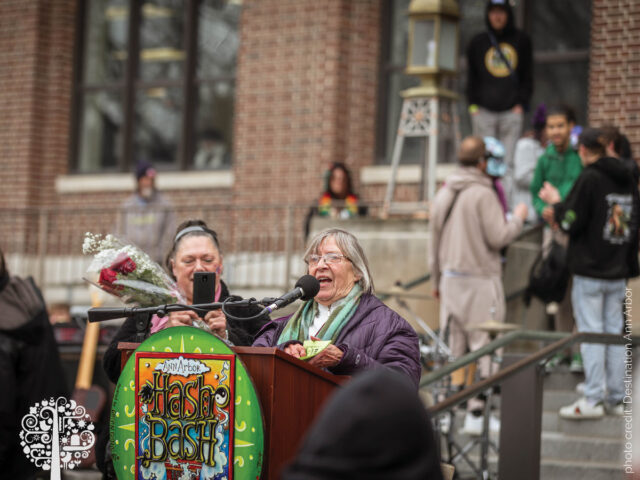
On the 50th anniversary, Hash Bash featured speeches, music, and new traditions, with Sinclair and state officials participating.
A Symbol of Progress and Ongoing Activism
From a ten-year sentence for two joints to thousands celebrating openly, Hash Bash has become a symbol of progress. The movement continues, with ongoing activism and new events like the Hash Bash Cup.
A Living Memorial and Broader Focus
After John Sinclair’s death in 2024, Hash Bash became a memorial and broadened its focus to human rights and drug decriminalization, raising funds to expunge records. Hash Bash is now an annual tradition and a key part of Michigan culture.
Looking Forward: The Legacy Continues
The movement for change continues, inspired by activists like John and Leni Sinclair. Every small positive change matters. Will you be part of the solution?
Hash Bash Demonstration takes place yearly, on the 1st Saturday of April, High Noon @ The Diag.
Cosmic Knot A.K.A Tom Wall, has made a name for himself by jamming with…PLANTS! Check out Tom’s article: Music: A Universal Language That Even Plants Love
