


I came to gardening, as many of us do, not necessarily out of a love of the natural world but because of a fascination with flowers. In the beginning, I was attracted to those big, vulgar things so often used as a punctuation mark within a planting scheme: the bright yellow colon of hollyhock or full-stop exclamation point brought by a sunflower’s radial symmetry.
When transitioning to garden design in my late twenties, I would occasionally send photos of floriferous encounters to my grandmother—enormous tree peony blooms at the Brooklyn Botanic Garden, or creamy magnolias from my
morning walk to work on the High Line. She was withering on her deathbed from Alzheimer’s, even though in my mind’s eye she will forever be crouched on her knees in the southern sun, toiling in a bed of dark pine mulch, her once-round cheeks surrounded by the acidic zing of wax begonias. The texts were sporadic because I didn’t know
how to talk about dying. It occurs to me now that in sending them I was probably, on some subconscious level, hoping to fill her back up.
When I was studying horticulture at BBG, I had a teacher who talked about the first time he actually saw a landscape: not in the literal sense, but as a composition that was made by the sum of its parts. He spoke of how he was able to tease out the nascent forbs from the grasses, to read the silvery underside of certain pioneering shrubs and understand how they were linked to the calciferous earth below. This, I think, is what separates everyday passion from some degree of expertise: an ability to identify and confidently theorize about the minutiae working together to create a larger whole. Strangely, I can’t remember much else about the course, or even what it was.
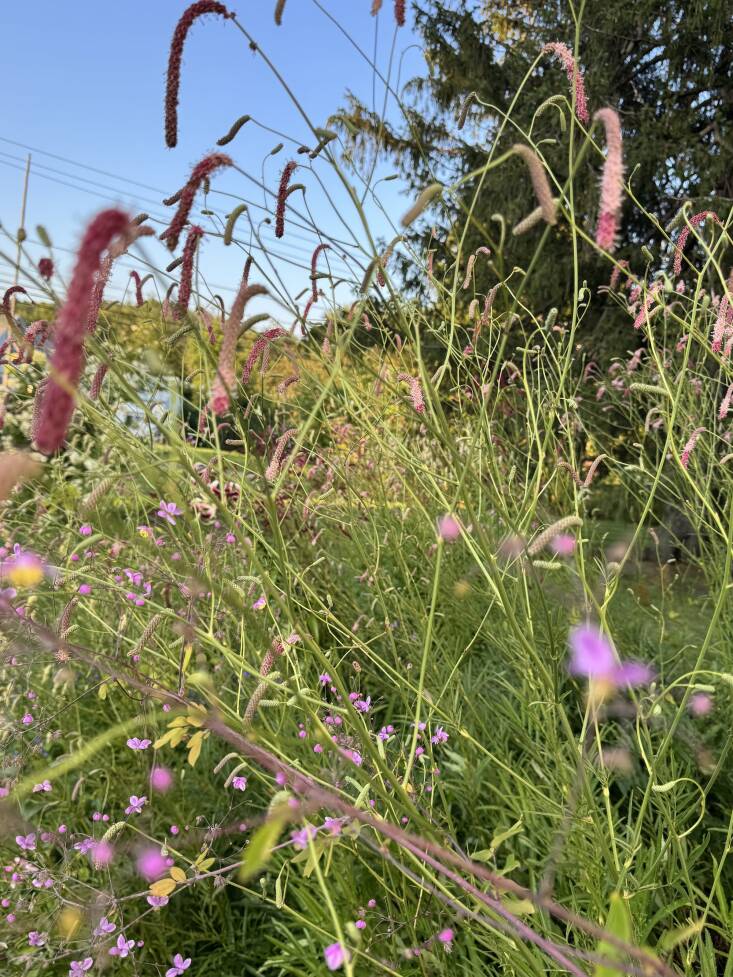
With practice, that ability to zoom in on the details slowly came to me as well. I first spotted the fine, merlot-colored dots of Sanguisorba officinalis peeking out at the very back of some naturalistic garden, hidden between drifts of grass and backdropped by a shock of yellow—maybe Amsonia? I’ve long lost the image, but it’s bookmarked still in my mind, a dog-eared mental page of something I wanted to add to my own garden if and when conditions would allow.
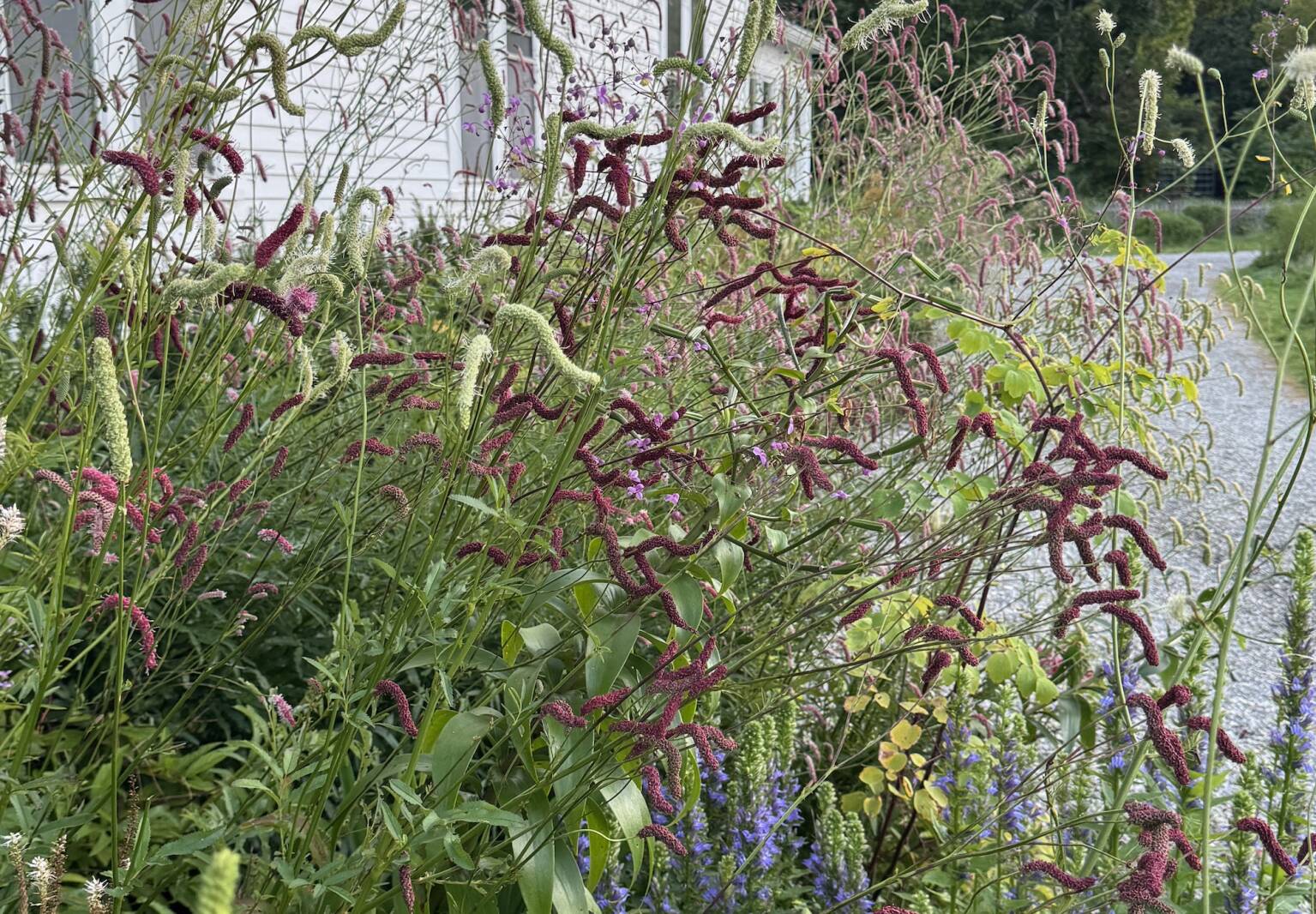
Fortunately, those conditions manifested in a northwest-facing bed in my Massachusetts garden, a small strip of earth that stretches along one side of my driveway. Its aspect and location are challenging—constantly drowned beneath the dripline, baked by gravel, and receiving anywhere from two to eight hours of harsh afternoon sun depending on the time of year. During the time that had passed between that initial sighting of Sanguisorba officinalis and the creation of this bed, my rolodex of the species had grown. Sanguisorba tenuifolia, S. armena, S. obtusa, and their myriad cultivars drifted in my mind, and although not all could or would ultimately make the list, I decided to give many of my favorites a shot.
