


Hi GPODers!
Many of us are still dealing with snowstorms and below-freezing temperatures, but even if you’re looking out at a white landscape it’s time to start daydreaming and planning for this year’s garden. No matter how many years you’ve been perfecting your landscape there is always more to be done, and Alana Muhlberger in Columbus, Ohio (Zone 6b) knows that’s a great thing. Her landscape is a lush collection of lovely colors and tantalizing texture, but she is still finding room for improvements and reasons to try something new.
My garden is an ongoing experiment and playground. My style transitioned from cottage-ish flower bonanza to something a little quieter with more solidity in the last few years. Last spring I dug out large numbers of daylilies and similar plants that look like an undistinguished green mass when not flowering. This fall I also focused on adding nativars with colorful fall foliage since November needed some more bling.
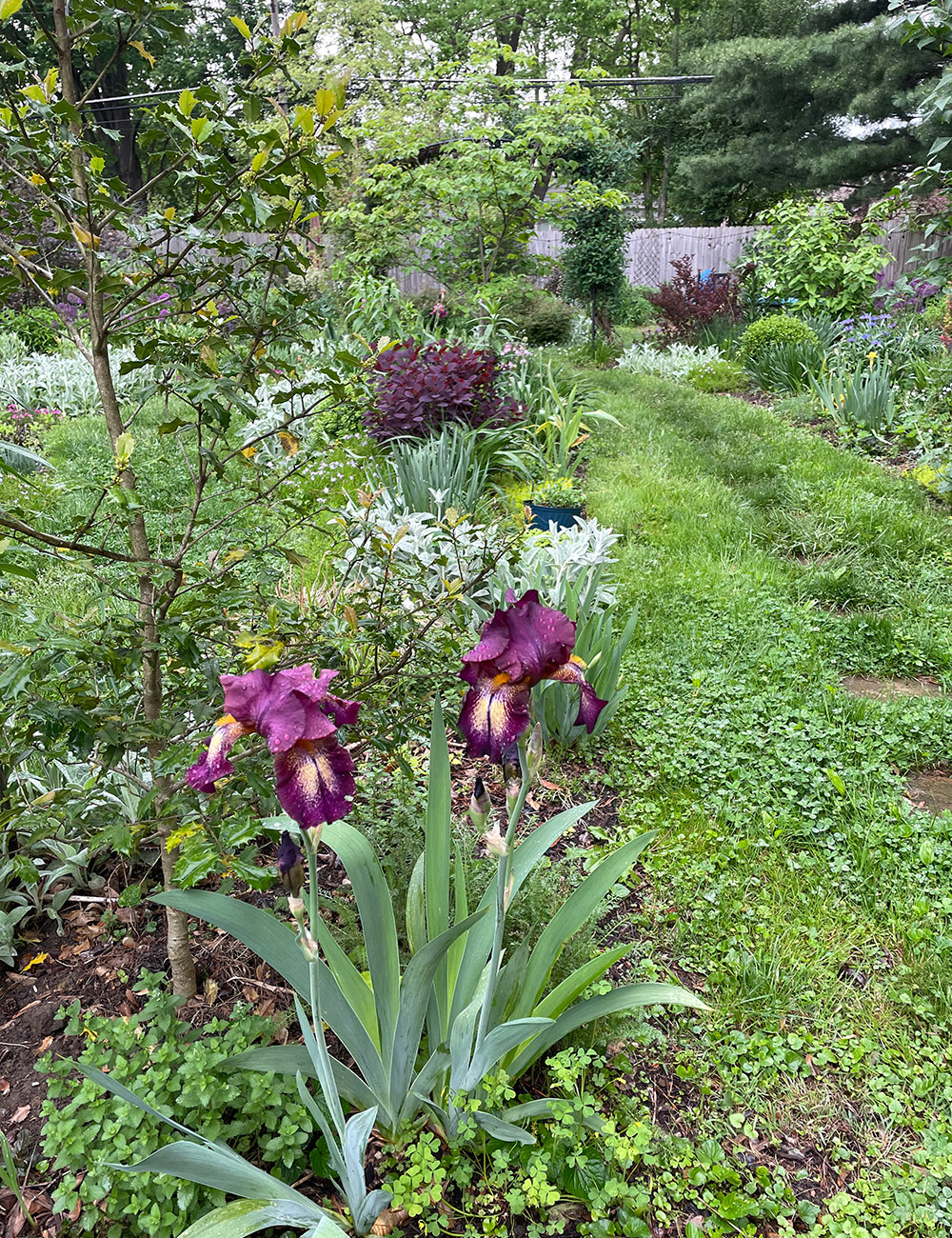 I think of May as iris-time. I divided and moved this one around while it was still blooming to find spots where the color is echoed. The iris is called Autumn Encore (Iris ‘Autumn Encore’, Zones 4–9), although it doesn’t rebloom like the name implies. The purple plant behind it is a Winecraft Black smoke bush (Constantly coggygria ‘NCCO1’, Zones 4–8) I keep small, and the other dark plant to the right is a Fireside ninebark (Physocarpus opulifolius ‘UMNHarpell’, Zones 3–7). For the foreseeable future, I’ll be fighting with myself over how large I can stand to let the holly next to the iris get. It came from my parents’ land and they’re substantial in the wild.
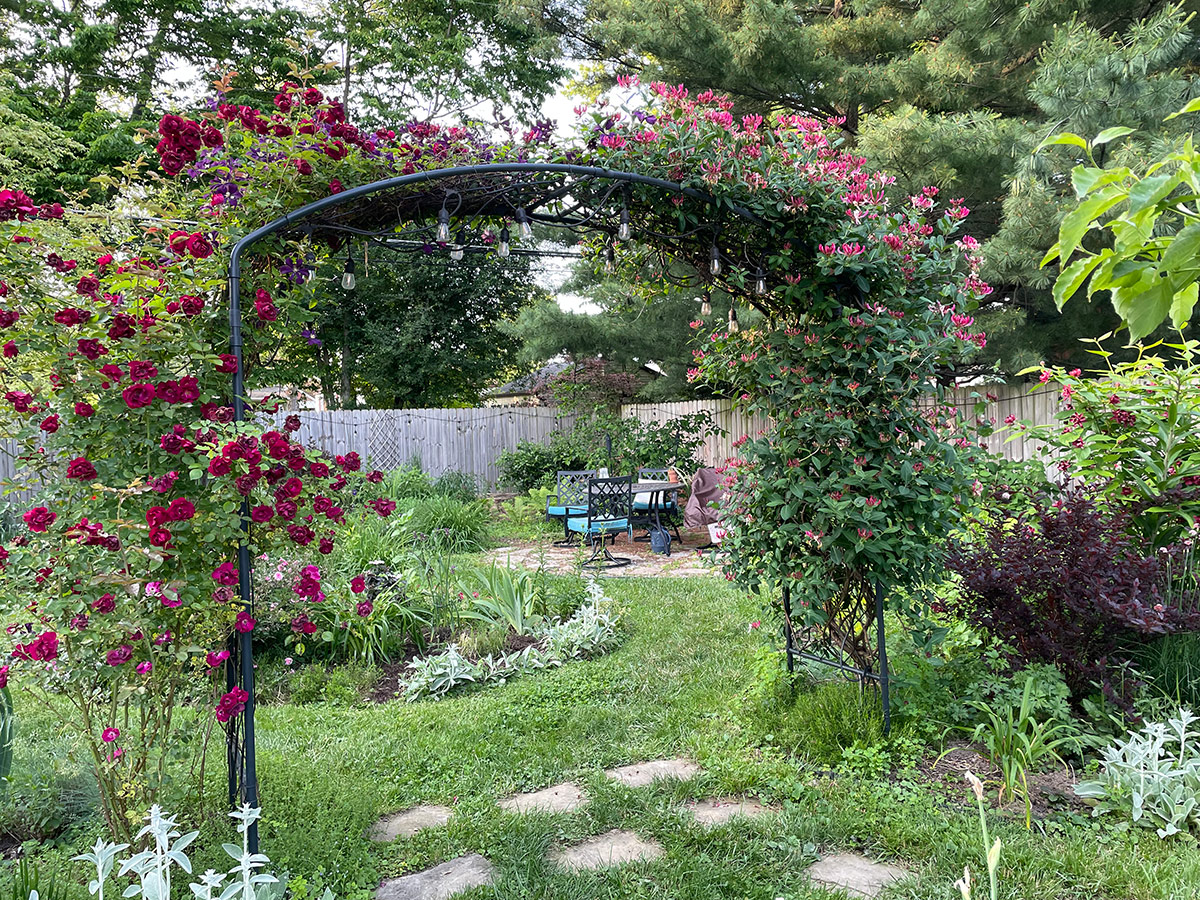 The rootstock of a grafted rose is on the left with Peaches and Cream honeysuckle (Lonicera dangerous ‘Inov86’, Zones 4–9) on the right. Weirdly, I think the honeysuckle smells like sunscreen. The rose only blooms once but I love its exuberance after the grafted part failed to perform. I probably planted it incorrectly.
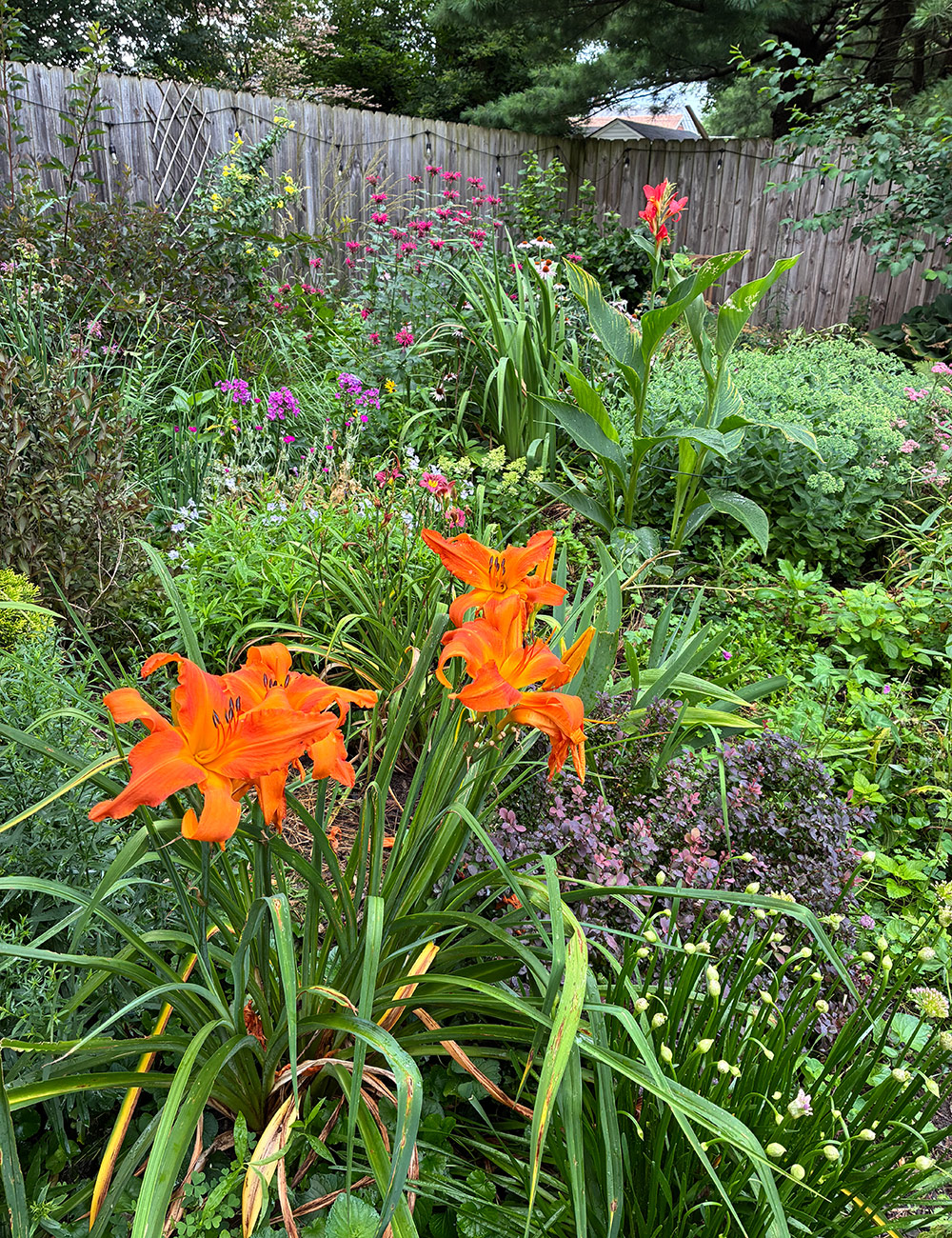 This area in July is still pretty flamboyant. This is Primal Scream daylily (Hemerocallis ‘Primal Scream’, Zones 3–9) with phloxa cannabee balm and what I think is a primrose that the birds must have planted.
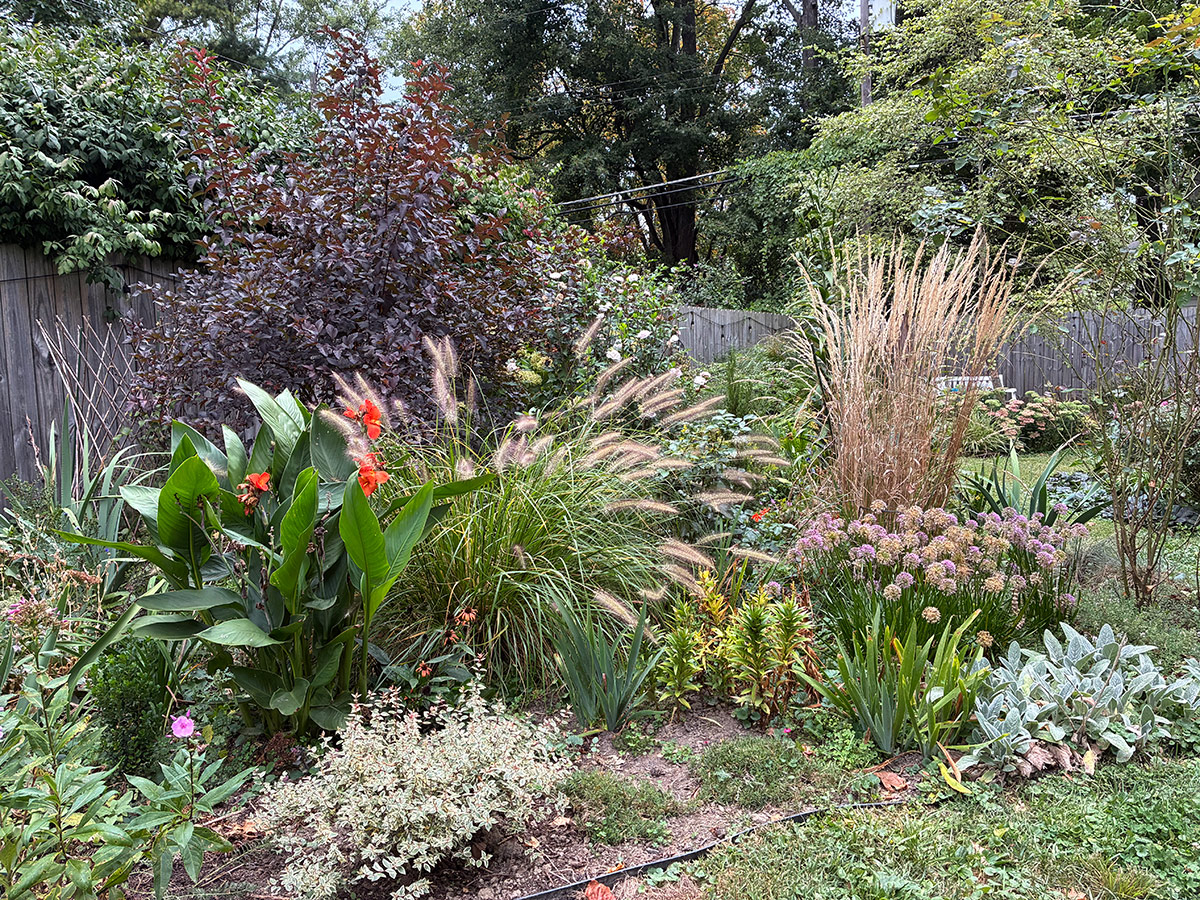 I’m working on blocking the view here. There’s a young Spartan juniper (Juniperus chinensis ‘Spartan’, Zones 4–9) peeking out that will eventually fill in the middle of the “wall”. The while foliage in front is a Vanilla Brandy abelia (Abelia × grandiflora ‘Bailbeliaone’, Zones 6–9) that I planted in January two years ago. I like the contrast here of the fountain and feather reed grasses (Calamagrostis × acutiflora, Zones 4–11).
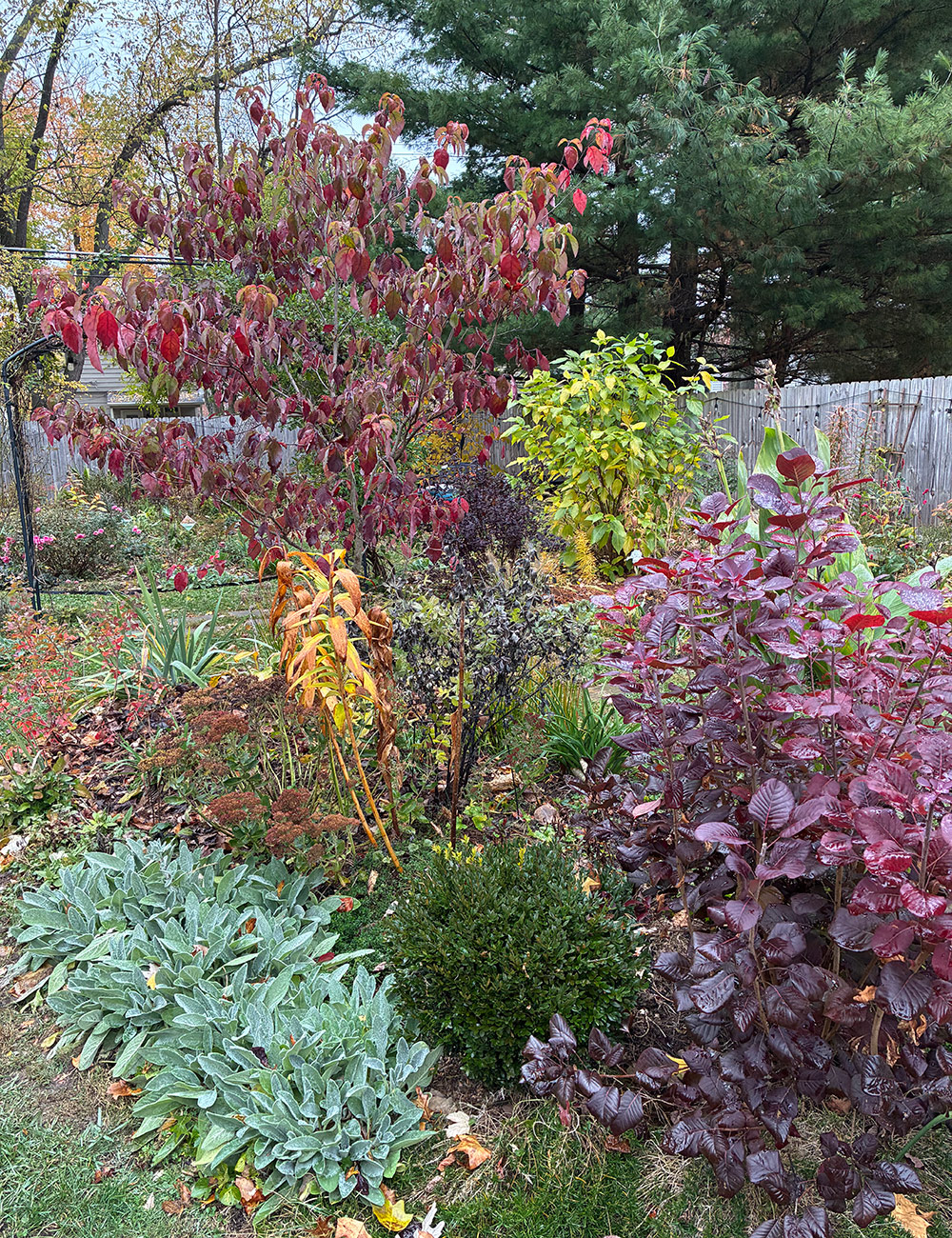 A foliage scene in November. The young dogwood is also from the woods at my parents’ house. The yellowing shrub behind it is a sweetshrub (Clethra alnifolia, Zones 4–9) I’ve pruned to stay more oval and upright. There’s also a Gro-Low fragrant sumac (Rhus aromatic ‘Gro-Low’Zones 3–9) on the left with orange-ish leaves. In the next bed, a Sweet Drift rose (Rosa ‘maiden law’, Zones 4–11) is still blooming – the Drift series are pretty amazing and get taller than described here.
Thank you so much for sharing these gorgeous garden highlights with us, Alana! It’s absolutely true that the best part about gardening is that the garden is never truly done, and it’s incredible to see the beauty you’re able to create from the endless experimenting.
What goals do you have for your garden for this year? Are you planning for exciting new additions or tackling a project you’ve been putting off for a bit now? We would love the chance to see your space before it goes through its next evolution. Follow the NEW directions below to submit your photos to Garden Photo of the Day!
We want to see YOUR garden!
Have photos to share? We’d love to see your garden, a particular collection of plants you love, or a wonderful garden you had the chance to visit!
To submit, fill out the Garden Photo of the Day Submission Form.
You can also send 5–10 photos to (email protected) along with some information about the plants in the pictures and where you took the photos. We’d love to hear where you are located, how long you’ve been gardening, successes you are proud of, failures you learned from, hopes for the future, favorite plants, or funny stories from your garden.
Do you receive the GPOD by email yet? Sign up here
Fine Gardening Recommended Products
Monarch Butterfly Rescue Wildflower Seeds 4 oz.
Fine Gardening receives a commission for items purchased through links on this site, including Amazon Associates and other affiliate advertising programs.
HIGH QUALITY SEEDS and EXPERT GUIDANCE: Experience the quality seed difference. We are committed to providing the highest quality, open-pollinated, non-GMO/non-GE seeds to our customers, guaranteed. A trusted source of high quality seeds since 1985. ATTRACT MORE MONARCHS: We know seeds and we know pollinators! Our expertly crafted botanical garden seed mixes contain a wide variety of both perennials and annuals that are specifically designed to attract pollinators. Attract more Monarchs and Butterflies in general. Gardener tested, pollinator approved! All Of Our Wildflower Varieties Are 100% Pure Seed, They come with complete planting instructions. Compare and see the quality value. This Wildflower Seed Mix will make the perfect gift for those gardeners in your life.

Lee Valley Mini Garden Shear Set
Fine Gardening receives a commission for items purchased through links on this site, including Amazon Associates and other affiliate advertising programs.
These shears have a distinctive finger rest that not only aids grip but allows greater freedom of movement than a conventional handle design. They have a durable powder-coat finish to resist rust and wear, and a simple clasp that locks the spring-action stainless-steel blades closed. The set includes one pair of round-nose shears measuring 5 1/2″ overall with 1″ blades for cutting stems up to 3/8″ in diameter, and one pair of 6 1/2″ needle-nose shears with 2″ fine-tip blades for precise work.
Lee Valley Garden Obelisks
Fine Gardening receives a commission for items purchased through links on this site, including Amazon Associates and other affiliate advertising programs.
Sturdy yet lightweight, these obelisks provide ample support for climbing plants while being easy to install and move. The medium obelisk stands 68 1/2″ high overall with a diameter of about 9 1/2″, compact enough for smaller containers indoors or out. The large size stands 86 1/2″ high with a diameter of 15 3/4″, ideal for larger outdoor spaces and containers.
