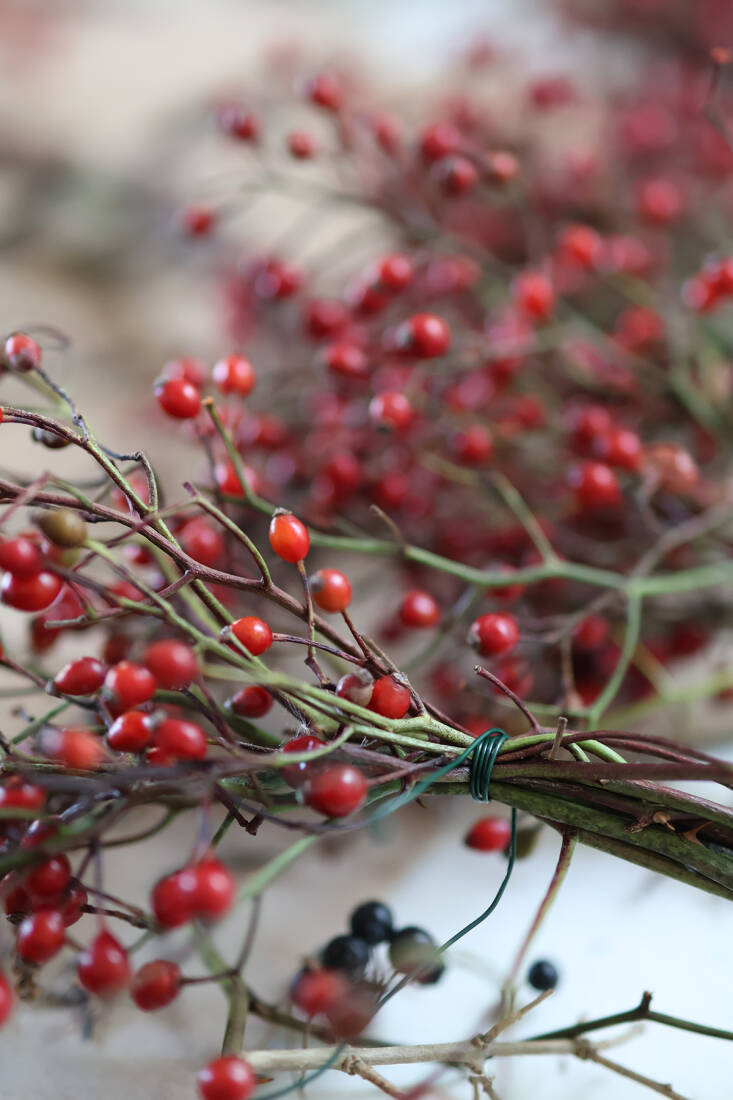



Making your own holiday wreath involves four good things: a brisk walk; a gathering of invasive plants like privet, multiflora roses, and bittersweet; a conversation—if you are brave—with a neighbor you have never met (in my case recently, this involved a trade of holly branches for me and a bottle of homemade elderberry cordial for them); and, finally, about two hours of focused attention on crafting and creativity. It is occupational therapy at its finest. Plus (five good things!) a really attractive wreath that will last for a month or more. Oh, and (six): Making your own wreath costs next to nothing.
Here are some of the plants you can use, and the minimal equipment you will need to make your own wreath at home.

1. Gather your materials.
The most effective wreath features plants that stay fresh-looking for weeks. Combining evergreens with winter berries and fruits guarantees long-lasting decoration. The plants can be foraged, if they are invasive, trimmed from your own garden, begged from your friendly neighbors, and bought from local tree vendors. You can also use trimming from your Christmas tree.
For color in a winter wreath, nothing beats rosehips. I take this opportunity to gather as many sprays of very invasive Rosa multiflora hips as I can find. Privet fruit is at its peak in early winter, and can be collected with a clear conscience, too. Holly, juniper, cedar, pine, fir and spruce are all good options for greenery.
In addition, you will need secateurs for cutting branches, gloves for sharp thorns, and, at home, florists’ wire for easy attachment. (A 22-gauge floral wire is easy to use and very strong.)