“I don’t do frilly,” say Diane Schaub, director of gardens at Central Park Conservancy. We are standing under the shade of an old magnolia in the English garden, one of three smaller gardens within Central Park’s six-acre Conservatory Garden near the northeast corner of the park. Schaub, who earned a diploma from the New York Botanical Garden’s School of Professional Horticulture, has been curating the Conservatory Garden for more than 30 years. And while she does not do frilly, she does do color and texture, breathtakingly well. She has a painter’s eye for composition and an architect’s instinct for structural detail.
Below, we share her best color combinations for fall garden beds:
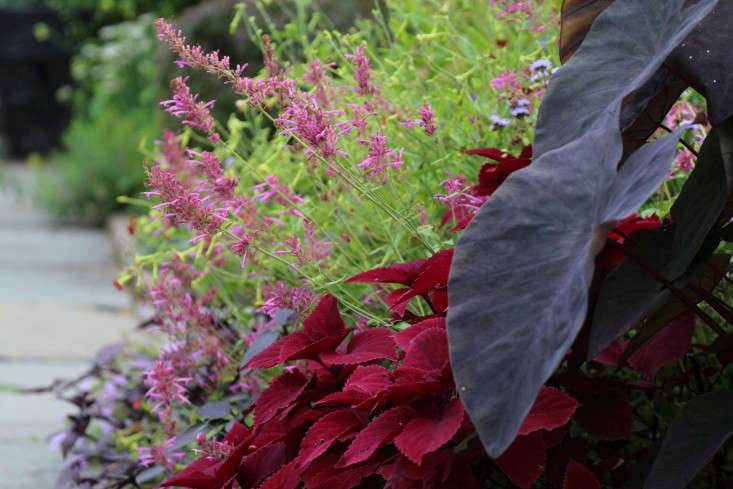
Above: “This is as frilly as I go,” she clarifies, indicating a velvet-leafed plant with burgundy leaves, beside the bluestone path. The plant in question is a Solenostemon (formerly classified as Coleus) and the cultivar is ‘Lancelot.’ Above: Solenostemon ‘Lancelot’ (paired with Salvia ‘Paul’) belongs to a crew of leafy annuals whose impact is felt dramatically in this garden, where the seasonal spectacle owes a great deal to plants whose interest lies in their foliage.
Purple + Yellow + Blue
Above: If you thought leaves were boring, think again. Solenostemon ‘Purple Prince’, black-leafed Dahlia ‘Mystic Illusion’, and Salvia farinacea ‘Victoria Blue.’
Above: A bed of Pennisetum setaceum ‘Rubrum’, Salvia x ‘Indigo Spires’, the leafy and lilac-striped Strobilanthes dyeranus, and elephant-eared Colocasia esculenta ‘Blue Hawaii’. The latter “makes the whole composition work,” says Schaub. Dark purple Pennisetum ‘Vertigo’ is in the background. Above: The English Garden is arranged in beds radiating from a central pond overhung by the largest crabapple tree in Central Park, leaves now turning yellow. Designed by Betty Sprout and opened in 1937, this part of the park was by the 1970s considered one of the most dangerous places in New York City. In 1980, the Central Park Conservancy was formed in response to the neglect the park had suffered in the previous two decades. Its founding director, Elizabeth Rogers, earmarked the Conservatory Gardens for renovation.